

First Bend of Yangtze River

Presentation of Shigu and the first curve of the Yangtze
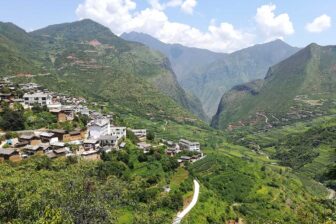
Jinshajiang (Golden Sands) River comes down from Qinghai-Tibetan Plateau to the South. When it arrives at Shigu, it is obstructed by Hailuo Mountain and forms a V-shape turn. Then it changes the direction and goes to the northeast. The curvature of this turn almost reaches a 140 degrees of angle. It is the First Bend of Yangtze River known through the world.
Jinshajiang River flows at great speed down to Shigu (Stone Drum) and then with the width of the river enlarged from here, the speed of the water gradually comes down and makes Shigu a natural ferry.
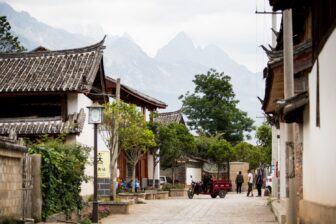
The First Bend of Yangtze River is approximately 70 kilometers away from Lijiang. To access to the First Bend of Yangtze River, we recommend you to stop about one hundred meters before the center of Shigu (Stone Drum) village and climb about 40 meters uphill from where you can see the magnificent view without any blocking. The way is not easy to find. If you don’t have any guide, the locals will be able to show you the way for some RMB.A visit to all beauty of the First Bend of Yangtze River would not be completed without a glance in the charming town close to Shigu, which was an important center of commerce on the Tea Horse Ancient Road between Dali and Tibet.
The village of Shigu is on the road between Lijiang and Shangri La. After an hour’s drive, take the road to Liming on the left. After a 10-minute drive (10RMB toll), you arrived at the village of Shigu. To continue on Shangri La, you will have to retrace your steps and continue the route where you had shot!
360° panorama above Shigu
Click on the arrow in the middle of the photo above and use the controls at the bottom of the photo to rotate the image 360 °.
First Bend of Yangtze River : visits around






Our travel ideas to personalizeSee all tours